Friday, March 13, 2009

Steak: It's what's for dinner Part II (Portfolio)

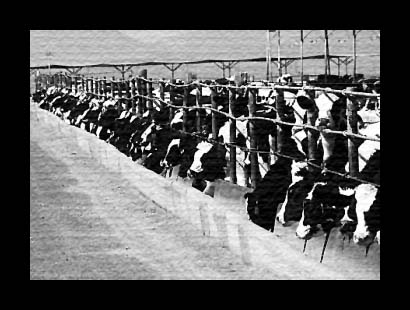
I couldn't help but revisit my steak eating experience, this time, however, from the cow's perspective. I am not going to lie, a good steak goes a long way to making me feel good. I can think of countless occasions when, over choosing a 'meatless' platter at some restaurant, I chose the steak (I did go to the steakhouse for a reason!). There is something about the juiciness of the meat, as well as the seasonings grilled into it, that just makes my mouth water. However, I must admit that I have found myself having the same satisfaction after eating a double big mac, super-sized. I was definitely missing something.

Each bite I take from my hamburger can almost be equivocated with going up to a cow in the pasture, or better yet, in a CAFO, and taking a bite out of it's hind quarters (I wouldn't recommend it, just picture it) My point is this: each time someone eats meat, there is an animal, somewhere, that had to die.

I have always been sensitive when it comes to animals. I remember on numerous occasions when an animal was hit by a car, like a deer, dog or bird; I would cry. The animal died because I hit it. I had similar feelings when it came to hunting animals. I couldn't bring myself to shoot them, and I just thought it was unethical (for lack of a better word) to kill them. Why then is it so easy to buy packaged meat at the store and eat it, but feel no remorse? The person eating the animal has just as much blame as the person who killed it. But, for some reason there is a disconnect between the animals and the people who eat them.


Michael Pollan, in his book "The Omnivore's Dilemma" said that "...most of us would simply rather not be reminded of exactly what meat is or what it takes to bring it to our plates (pp 305). He argues that the reason we don't know where our meat comes from, and how it gets to our plates, is simple: if the consumer knows, then the producer wont sell as much meat. This is one reason why slaughterhouses are off limits to everyone but the people who work in them. It seems like a good PR strategy to me. The question is, "Is it right, or is it wrong?" or, "It there a real answer to this question?"

It is hard for me to say, exactly. I suppose I could purport that it depends on the situation. However, learning about the process of turning a cow into a steak has definitely opened my eyes. Though I am not going to turn vegetarian or vegan, I am definitely going to think a little bit more about what I eat. I also know that I have eliminated my reservations for hunting. It's not that I have stopped abhorring the fact that I am ending the life of another animal. In fact, I think it goes beyond that. I am killing an animal any time I eat meat; therefore, I would rather know where my meat came from and how it got to my plate, then not have any clue if what I am eating really is what the packaging claims it to be.

Corn for Everyone...Even the Corn (Portfolio)

I can remember hearing, for the longest time, that there is a shortage of corn. I always took this as truth and never thought anything about it. So, when the government decided to put ethanol as a requirement for gasoline, I thought the price of my corn tortillas was going to go through the roof.

I was under the impression that the laws of supply and demand were going to make the prices of all my food go up, because I was aware that there really was corn in everything. What I failed to recognize is that, though there might be corn shortages in other countries (this would be locally grown corn), saying that there is a shortage of corn in the United States is about as far from the truth as the Moon is from the Earth.


The first section in Michael Pollan's book ,"The Omnivore's Dilemma," I received an eye opening education: the only corn shortage we have in America is a shortage of corn farmers. As it turns out, because of advances in agricultural technology there are mountains of corn (like the one pictured above) all over the Midwest (this corn didn't fit in the silo behind it).

There is so much 'extra' corn, if fact, that agribusiness has had to find numerous ways to use the corn. Among the uses are feeding farm animals on CAFOs (Concentrated Animal Feeding Operations) and, by means of state of the art chemistry, coming up with, get this, hundreds of different organic compounds (Pollan, pp 86). I can understand maybe coming up with a few different compounds just for the heck of it, but hundreds is an entirely different story. There has to be a ton of corn! The most common compound is High Fructose Corn Syrup, and it has long been used as a cheaper sweetener than cane sugar. Why, one might ask? Supply and demand: the surplus of corn is so immense that the prices to produce these compounds has naturally decreased until it fell through the floor.

My concern here is simple: why was I told that there was a corn shortage? Someone doesn't want me to know, and they have gone to great length to make sure I don't find out. My solution? I'll just start reading the ingredient lists on my food, and do my part to get out of the corn trap.

Take it to the Bank

I have spent hours of my time in attempting to find food for the needy. Being a part of the Boy Scouts of America, as well as the Church of Jesus Christ of Latter Day Saints, volunteer time is something that just naturally occurred. I always saw myself as doing something for the betterment of society, giving back to people who didn't have anything themselves, or just being plain charitable.

I always had a certain amount of sympathy for the people who needed the food. I never personally knew anyone who did, but I occasionally saw someone, in my rural town of Stanwood, WA, walking in the rain and wind, dressed in what I would call rags, obviously going somewhere, and naturally I pitied them. These people were the ones I pictured on the receiving end of the free food I helped gather. I felt this way until, in a chance of fate, I ended being on the receiving end of the volunteer service.

My first visit to the food bank for myself and my family was, for me, a very embarrassing experience. I was worried that I might see someone I knew, or that, even worse, they would recognize me. However, I consider my feelings felt at the food bank as immaterial when I think of why I needed to go.

Why is it that, even though there is a very large surplus of food in the United States, there are hungry people everywhere? I suppose that when the all powerful dollar is pushed before food justice, there will always be a surplus. That's how capitalism works. A surplus is needed to make money. The answer to my question is quite simple. There is a disconnect between food and people, and this is because of money. Food is no longer seen as a means to feed people, per say, but as a means to make money. Food banks are a product of this line of thinking. I would go so far as to say that food banks exist, not necessarily to feed the hungry, but rather to convince people who have money to buy food that the problem of hunger is being solved.

Janet Poppendieck go a step further and says that "...the food banks realize they need hunger as an issue in order to raise their funds (p 133)." The food banks will not, or cannot, exist without hunger. They are just as capitalist as the rest of America. Money is needed to survive, and food banks have found a way to make money.

Now, food banks aren't all bad, they do feed hungry people; however, they treat hunger, according to Poppendieck, as a disease, and not a symptom. Hunger is treated independently from low wages, poverty, and many other things. Being poor myself, there is definitely a connection between the amount of money I have and the food I eat. There is rent, bills, school, food, clothing, etc, but I don't hear the same fervor coming to stop these equally pressing issues. These are the places I see myself and Poppendieck running together.

But I am at odds with the steps that should be taken. I do not believe that the government can do anything and create the correct system, too many puffy egos are involved. Things need to be done on a large scale, but personal basis. There must be a movement to change the present that comes from the ground up. The government can educate, but legislation would just prove meddlesome. If things are going to change they must be changed willingly. I know I am waxing utopic to an extent, and I don't know if any of the things I suggested are even possible, but I do know what I want to do for myself and for the people that I know.